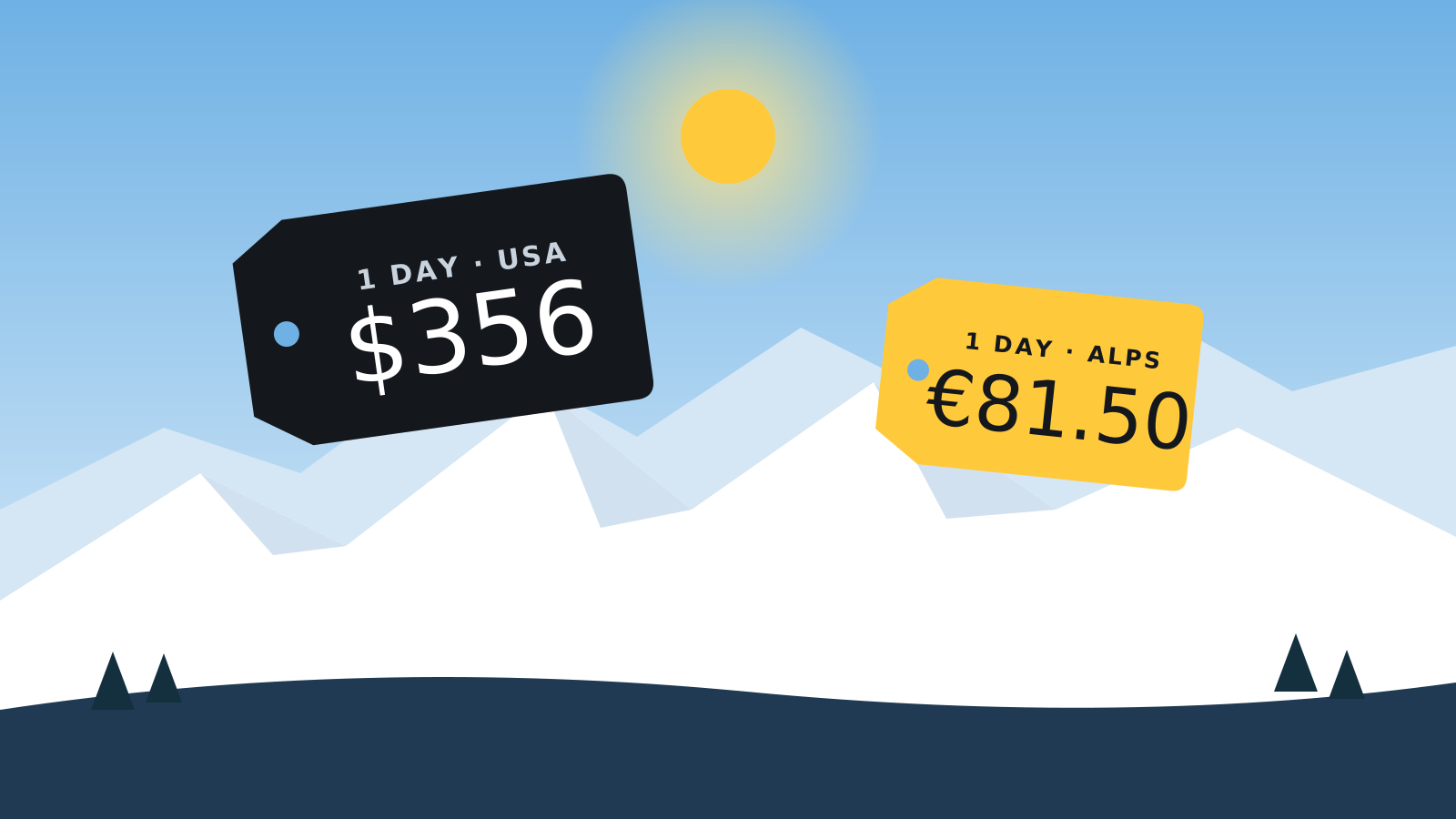
If you ski in the US, you know the feeling at the ticket window. For the 2025/26 season, a peak-day lift ticket at Vail or Beaver Creek costs $356. In the Alps, that money buys you more than three days on some of the biggest ski areas in the world.
Price isn’t the only difference, though. Here’s what to expect when you swap the Rockies for the Alps.
Lift tickets: the numbers
Single-day adult tickets for the 2025/26 season, as published before the season:
| Resort | Day ticket | Size of the ski area |
|---|---|---|
| Vail, Colorado | $356 (peak) | one mountain |
| Park City, Utah | $351 (peak) | one resort |
| Breckenridge, Colorado | $321 (peak) | one resort |
| Ski Arlberg (St. Anton, Lech), Austria | €81.50 | 302 km of pistes plus 200 km of ski routes |
| Ischgl / Samnaun, Austria & Switzerland | €79 | Silvretta Arena, two countries |
| Zermatt, Switzerland | from CHF 88 (dynamic) | linked to Cervinia in Italy |
| Verbier / 4 Vallées, Switzerland | from CHF 77 | one of Switzerland’s largest ski areas |
Put simply: six full days on the whole Ski Arlberg area at the day-ticket price come to €489. That’s less than two peak days at Vail ($712).
To be fair to the US: if you buy weeks ahead or hold an Epic or Ikon pass, you pay far less than the window price. But many visitors don’t, and in the Alps there’s no need to plan your skiing around a pass at all. The standard rate is simply reasonable.
The ski areas are huge, and they link villages
In the US, a ski resort is usually one mountain with one base area. In the Alps, a ski area often links several villages, valleys and sometimes two countries. You can ski from Zermatt to Cervinia in Italy for lunch, or from St. Anton to Lech and back in a day. A week is rarely enough to ski everything.
Lunch is a highlight, not a cafeteria
Forget the overpriced burger in a crowded base lodge. Alpine ski areas are dotted with mountain huts and restaurants with table service, sun terraces, wine lists and proper cooking. In places like Zermatt, Lech and Alta Badia, people plan their ski day around lunch. Book a table, take your time, and ski it off in the afternoon.
Villages that grew, not resorts that were built
This is the difference our guests talk about most. Many of the big American ski resorts were planned and built for skiing: Vail opened in 1962, Beaver Creek in 1980. They’re superbly run, but the village came with the lifts.
In Switzerland, Austria and Italy it’s the other way round. The villages were there first, as farming communities, trading towns and mountaineering bases, and skiing grew into them over a century:
- Kitzbühel received its town charter in 1271, and its painted medieval old town is still the heart of the resort.
- Zermatt became famous with the first ascent of the Matterhorn in 1865, long before the first ski lift, and it is still car-free.
- St. Anton is where modern ski teaching was shaped: the Ski Club Arlberg was founded there in 1901.
- Alta Badia is home to the Ladin people, with their own language, cuisine and farmhouses that have stood for centuries.
That history is what you feel in the evening: a church square instead of a base-area plaza, a family-run hotel in its fourth generation instead of a condo complex, a farmer’s cheese at lunch instead of a food court.
To be fair: the US has some wonderful old mining towns, such as Aspen, Breckenridge, Park City and Telluride. And in France, several big resorts were purpose-built in the 20th century too. But nowhere is there such a density of genuine, lived-in mountain villages as in the Swiss, Austrian and Italian Alps.
You sleep lower
Breckenridge sits at around 2,900 m (9,600 ft). Zermatt’s village is at 1,620 m, Lech at 1,450 m, St. Anton at 1,304 m, while the skiing goes up to 2,800 to 3,900 m. You sleep lower, which most people notice in how they feel on the first nights.
Piste colours work differently
Europe uses blue, red and black, with no green. As a rough guide: an Alpine blue is an easy run, a red is a solid intermediate run, and a black is steep and often ungroomed in places. There’s also a fourth category: ski routes (marked, avalanche-controlled but never groomed), which have no real US equivalent.
Important: off-piste in the Alps means off. Outside the marked runs and ski routes, the terrain is not patrolled or avalanche-controlled. Always ski it with a certified mountain guide.
Snow: different, not worse
The Rockies and the Wasatch are famous for dry, light powder. The Alps get more variable weather, but the high resorts are reliable: at the measuring stations in Zermatt’s and Verbier’s ski areas, the snowpack typically peaks at over 2 metres. Grooming is excellent, and the high-altitude and glacier areas ski well from December to April. You’ll find the snow statistics in each of our resort guides.
Hotels: half board and ski-in
In Austria and Italy especially, many hotels include half board: breakfast and a multi-course dinner. That changes the maths of a ski week considerably. Ski-in, ski-out hotels exist, but many of the best addresses are in the village centre, a short walk or shuttle from the lifts. What the hotel location terms really mean.
Getting there
From the US East Coast, overnight flights reach Zurich, Geneva, Munich or Milan in around 8 hours. From there, trains and transfers take you to most resorts in 1.5 to 3.5 hours. Zermatt and St. Anton even have their own railway stations, so you can travel from the airport to the slopes without a car.
So what does a week cost?
Lift tickets are only part of it. To give you an honest idea of the full picture, we’ve put together sample trips with price ranges: from a family week in Austria to a five-star week under the Matterhorn.
Not sure which resort fits you? Try our resort finder: five quick questions, and you’ll see the Alpine resorts that match the way you like to ski.
Sources for lift ticket prices: SnowBrains (Vail Resorts 2025/26 peak rates, published August 2025) and 1000things (Austria and Switzerland 2025/26). Prices change during the season; always check the current rate.